The Vulnerability of Self

'The Bike Messenger'

'The Bike Messenger'

Over dinner with some friends recently I was introduced to someone who, while having a successful business career, also described herself as ‘an artist’. The deliberate use of that moniker was interesting and I asked at what point in her creative journey she had finally felt comfortable using that title.  She acknowledged the validity of the question and explained that it had taken her completion of an under graduate degree in Fine Art before she finally felt justified in calling herself an artist. Ironically for me as an observer, all it took was a look at her work (she’s a sculptor and an incredibly talented one) to see the artist and not just the person.

Self-doubt has long been a feature of the creative process and of artists in general. For sure I don’t consider myself an artist and until recently the word ‘just’ was quite deliberately used before the self-description of ‘amateur photographer’ on the front page of this website. When asked why by a friend, I explained it was deliberately self-deprecating; I didn’t consider myself good enough to call myself an amateur photographer just yet. That term, to my reading at least, connotes some degree of proficiency and talent I wasn’t sure I possessed. We agreed I would remove after her reassurance that I was more than talented enough. As a graphic designer, she routinely works with and appraises various photographers work so she should know, and yet the doubts still linger…..
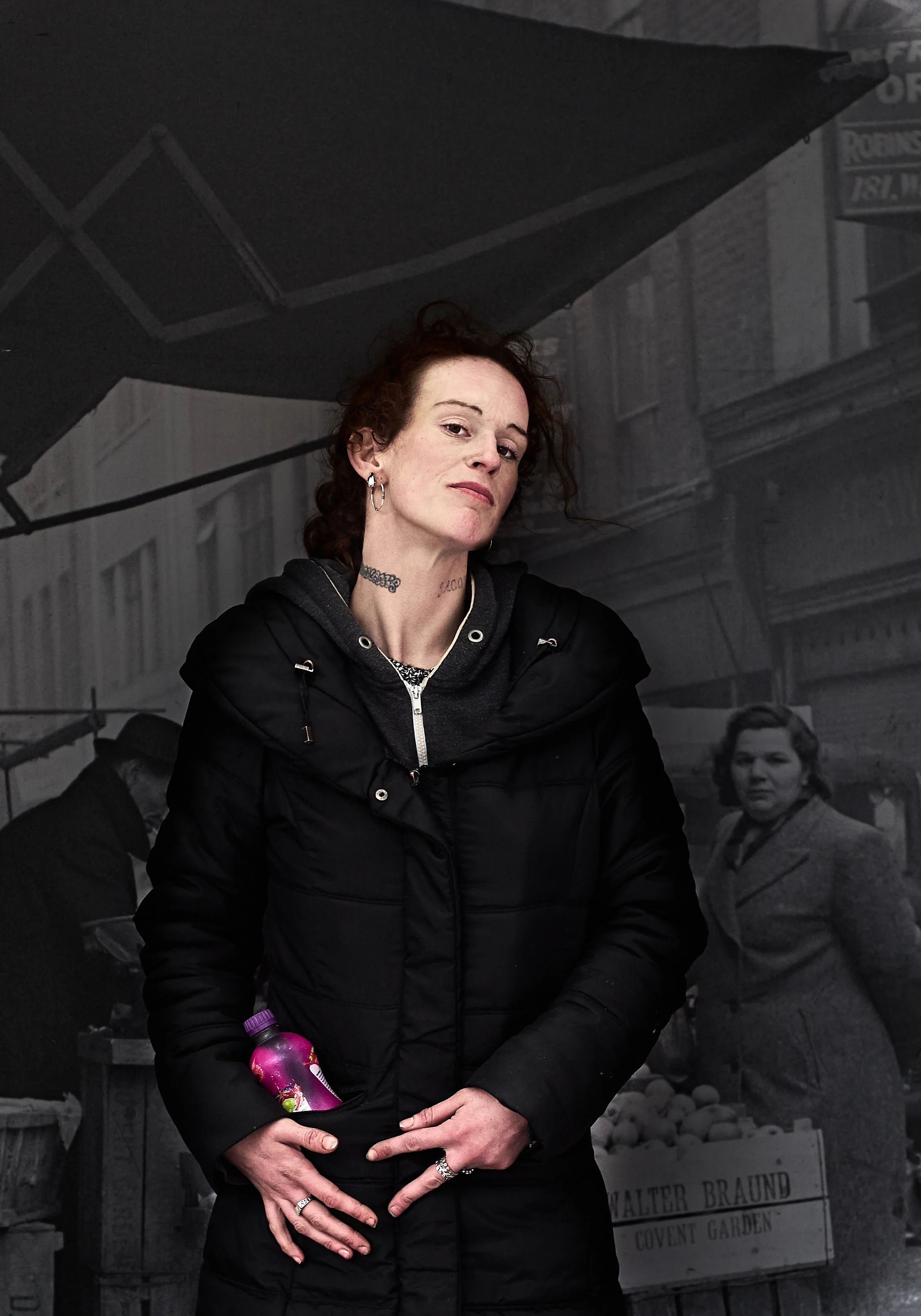
'Tina'

'Tina'

I started this project as a way of examining the concept of the person and the three manifestations of any individual. The more photographs I take though, the more I realise that I am exploring that concept from the perspective of self as much as anything else and that process is similarly tinged with self doubt and vulnerability. I guess I’m exercising my own demons such as they are; the little boy at Catholic primary school who while not subject to physical abuse, was exposed to prolonged and painful emotional abuse. It has an effect that is carried through to adulthood and at various stages in life is processed through different lenses, if you will excuse the pun. The current lens I am using is both metaphorical and literal.

There is a certain irony with using the camera lens to explore that vulnerability and self-doubt. Traditionally, it is the subject that is more nervous of the lens because it’s their vulnerability or self-doubt that is being observed if not exposed. For me, the fear and doubt is as equal behind the lens as in front of it, it’s that mirror phase again with the subject looking back at me, being me.

'The Film Producer'

'The Film Producer'

The three portraits on this blog say a lot on this subject. In the first, ‘The Bike Messenger’, the pose is relaxed but the cigarette and the off camera look show tension; he’s relaxed but not completely. The tension is probably the reflection that he’s just agreed to have his picture taken by some random stranger in Soho. I imagine he’s having second thoughts but isn’t sure how to get out of it. This is self-doubt brought about by the sudden vulnerability of the situation.

In the second, ‘Tina’, we see a very different story. It was her tattoos that immediately caught my eye and why I asked if I could take her picture. Her immediate response was to ask for spare change in return, as she was homeless. I agreed and she posed quite freely but her pose is at once both vulnerable and defiant. The way she holds her head shows strength, you can see the muscular structure of her neck suggesting that physical strength, the look in her eyes and of course, the obvious hand gesture, which I confess I did not see at the moment I took the picture and initially cropped out. And yet she is intensely vulnerable, after all she has just asked for money because of her situation.

The last picture is the polar opposite. ‘The Film Producer’ shows a man consummately at ease with himself. He knows who he is, he knows what he likes and he is very comfortable with that. There is not the slightest hint of vulnerability here or at least, any vulnerability or self-doubt that may have once been has long since been forgotten.

Of course, all this could just be complete nonsense. The pictures could well be no better than something you’d have developed at Happy Snaps and my reflecting on them over intellectualised nonsense (actually that part probably is true; I hope the pictures are a little better than snaps though).

Visual Pleasure and Narative Photography

The title of this post references the famous essay by Laura Mulvey on the principles of viewing pleasure in the cinema titled 'Visual Pleasure and Narative Cinema'.

'The Man In-Front of You'

'The Man In-Front of You'

I recently did a photoshoot with my dad ('Dad') who suffers from ‘frontal lobe dementia’. It’s a difficult condition to have in someone you love, someone who inspired you and who you want to remember as the great man in your childhood. The condition means that while he is still present and lucid to a relatively high level, he has lost the ability to perceive how others perceive him. He sees others but he has no ability to conceive of how others see him. It can make his behaviour very challenging (it’s not unlike dealing with a three year old) and as a result of the conflict that arises he has retreated quite a bit. It’s almost as if his coping strategy is to not engage in order to avoid the conflict. I’ve no idea if this mechanism is correct or not, but the reality that he is more ‘vacant’ these days certainly is.

In taking his portrait I wanted to achieve a number of things. Primarily I wanted to try and connect with his condition and with his experience of it. In doing that, I wanted to gain some insight into his experience (him as he sees himself) and thus reconnect with him myself. That’s a deeply uncomfortable proposition though and so it’s no surprise that no one seems to like the pictures I’ve made, not least my family.

My brother challenged my directly on this, saying that it would have been far better to capture the last sparks of who he was. There is a lot of merit to doing that. I think it’s a different project though there were one or two images from the session that did do just that. But the discomfort my brother experienced in the other images, and felt the need to (rightly and justifiably) comment on is perhaps more interesting.

It is part of a general trend I’ve noticed in attitudes towards portraits that dictates there is a formula for how these should be done; that a portrait of someone you know, for most people, should be something warm and positive. I’ve noticed this especially when I post self-portraits on social media and I get the usual round of comments about looking grumpy, or stern, or too intense or something else other than the clichéd happy/warm/positive you would expect from a picture you share of yourself with the world.

'Mother'

'Mother'

People are very uncomfortable with seeing something other than that. Maybe they are OK with it in an art gallery, where there is an understanding that you might see something you’re not comfortable with and even if you experience that discomfort, you know it’s temporary and therefore of no consequence. It’s different when it’s someone you know. There is nothing temporary about it. Whatever it is that you see, even if you put it out of your mind it’s still there.

I had a similar conversation with a friend of mine who is at the start of exploring gender transition. We’ve talked about making a series of images of him as a record of that process. His motivation is documentation and mine is the creative process, which naturally means I would want to ‘publish’ those images at some point. In discussing that with him, he commented that he wasn’t sure there would ever be a time when he was comfortable with that (which then seemed to limit my interest in the project – a subject for another post about the creative process). He said that having the permanent record of something painful like that was both a risk and challenging to him. My point was that there is always a permanent record and the existence of a photograph is irrelevant to that fact. You exist in the world and people experience you in it and in doing so, that creates a permanent record that can never be erased. A photograph might add to the collective memory, but it doesn’t solely define it.

It’s not difficult to understand where this discomfort comes from. It’s tied into Laing’s ‘I see you, you see me’ concept. We see ourselves. We know other people see us but we cannot experience that experience. We also know that there is us as we really are and that this reality probably sits somewhere between the experience of self and the experience other people have of us. The perception of self is usually built to help us feel good about things. Whatever someone else might think of us, we can put that away as less important because we know we can’t experience it. But the photograph breaks down that invisible barrier. It shows us what other people might see and therefore creates some discomfort if the images shows something other than the warm, positive, comforting image we have created for ourselves.

'Rememberance'

'Rememberance'

This explains why people react badly to their own picture which might then contradict that self-image, but why does the same thing happen when you show them a picture of someone else that they know?

Jacques Lacan described the process of ego creation in a young child as being greatly stimulated by the recognition of self in a mirror. That recognition usually takes place at a time when the child’s ambitions greatly outstrip their motor development and so they see the reflection as being far more capable than they really are. That process creates a sense of comfort and satisfaction that stimulates the creation of ego.

This theory has been developed to explain some of the principles behind the pleasure of cinema. It states that the act of observing the capable, all conquering hero on screen is akin to this process of self-recognition. It reminds us of that moment and in doing so, we see ourselves in the hero and we are comforted.

The same could apply to the viewing of portraits and is perhaps even more powerful in a portrait of someone we know and love so that when that picture is not one that conveys the positive aspects we associate with them, it actually serves to remind us of our own insecurities. It is if you like, the inverse function of watching the hero on screen.

Blink and you'll miss it

Our children are only children for a short time and these days that window seems to be getting even briefer. One of the reasons I got back into taking pictures (from having dabbled with photography on and off for a number of years, the last flirtation being in 2003) was to record that window as best I could. It's also one of the reasons I called this site what I did (that and the fact that 'Blade Runner' has always been my favourite film even from before when it was cool to say that).

We have some friends we haven’t seen for probably over a year. Their son, Albie, is the same age as our eldest and while we keep up on social media, life of late really has taken over. So when the other day they did a very sweet and charitable thing for me, quite out of the blue and in response to a tongue in cheek comment I’d made on Facebook, I wanted to find a way to say thank you that was a bit more sincere than just food or wine.

About 18 months ago the Tour of Britain passed through Horsham and being keen cyclists, our friends and I went to watch the race. I had my camera with me and among the pictures I got was a half decent one of Albie, waiting pensively for the peloton to race through. I thought I would do a new edit of that picture to see if I could produce something that would be worthy of printing and keeping and this is the result. It works much better in B&W and makes a lovely print.

It’s one of those moments to have a record of. We went round for lunch today and caught up properly. Apart from how much the boys have grown in such a short space of time, I was struck by how much their life had changed in that time to. Jobs lost and found, reconciliations made within their family that had been broken for 19 years, boys getting bigger, life moving on.

The picture is just a picture but it was also the reason to reconnect and catch up.